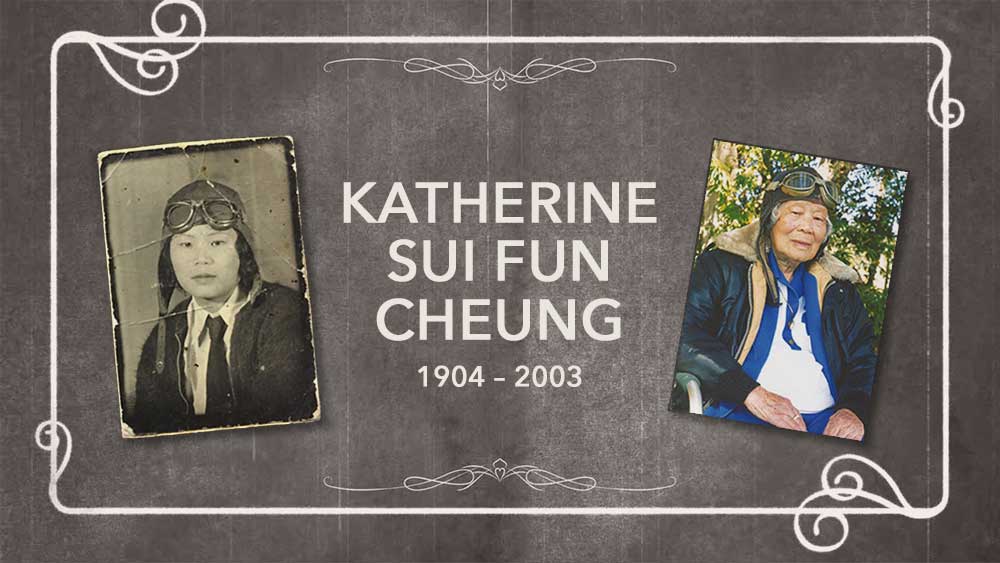
Barnstorming Through Barriers
"I don't see any valid reason why a Chinese woman can't be as good a pilot as anyone else. ... We drive automobiles – why not fly airplanes!" —KATHERINE CHEUNG
To say Katherine Sui Fun Cheung was a rarity is an understatement. When she became the first Chinese woman to earn her pilot's license in the United States, women pilots were scarce. Women made up only one percent of licensed pilots, and, as a woman of color, she was one percent of that one percent.
The story goes, according to filmmaker Ed Moy, that the idea for Katherine to take flight began when she was learning how to drive in a lot next to what was known as Dycer Airfield in Los Angeles. After her father gave her driving lessons, they’d park the car and watch the planes take off and land.
Katherine was born December 12, 1904 in Enping, China. In 1921, she moved to the US to study music, graduating from Los Angeles Conservatory of Music and continuing her studies at University of Southern California and Cal Poly Pomona.
In the 1930s, women weren’t allowed to join flight school in China, but the U.S. was a different story.
“I thought it over and I said ‘well, I’m over here, I can do anything I want, why shouldn’t I do it?’” recalled Katherine in an old interview with a local TV station.
Although she had an interest in flying, several life events occured before she got into the pilot’s seat. Katherine taught music, married her dad’s business partner and had two daughters.
Around this time, every airpark had aviation clubs, but most were segregated by race or gender. People excluded by white male aviation clubs formed their own groups. Katherine’s father and her male cousins were members of the Chinese Aeronautical Association of Los Angeles.
One of her friends from Guangzhou, China, wrote to her in 1929 saying that many women wanted to join the local aviation school, but weren’t allowed. According to a book published by China’s Sun Yat-Sen Library of Guangdong Province in 1987, Katherine got so angry and said: "Don't say women cannot fly. We're heading to the sky."
Katherine was never one for tradition.
When Katherine agreed to marry her husband, there were two conditions. The first was that she would keep her maiden name and the second was that he supported her dream of learning to fly.
“He didn’t really have a choice,” Katherine would later recount in an interview. “But he was more enlightened than most men [of that time] so it wasn’t an issue with him at all.”
Katherine signed up for flying lessons in 1931 through the Chinese Aeronautical Association and took her first solo flight after logging just 12 and a half hours in the air. She earned her pilot's license in 1932, officially becoming the first Chinese woman pilot.
Katherine evenually joined the all-women air group, the Ninety-Nines, founded by Amelia Earhart. She was not simply a hobbist pilot, but one who performed death-defying stunts like loops, barrel rolls and participated in air races.
She was part of a wave of Asian women making history in aviation. Soon after, Leah Hing, of Portland, Oregon, earned her license and is considered first American-born Chinese woman pilot. Hazel Ying Lee, also based in Portland, got her license too and began her own illustrious career, becoming the first Chinese American woman to fly for the U.S. Women Airforce Service Pilots (WASP) during WWII. In Boston, Rose Lok also got her license the same year while joining the Chinese Patriotic Flying Corps in 1932.
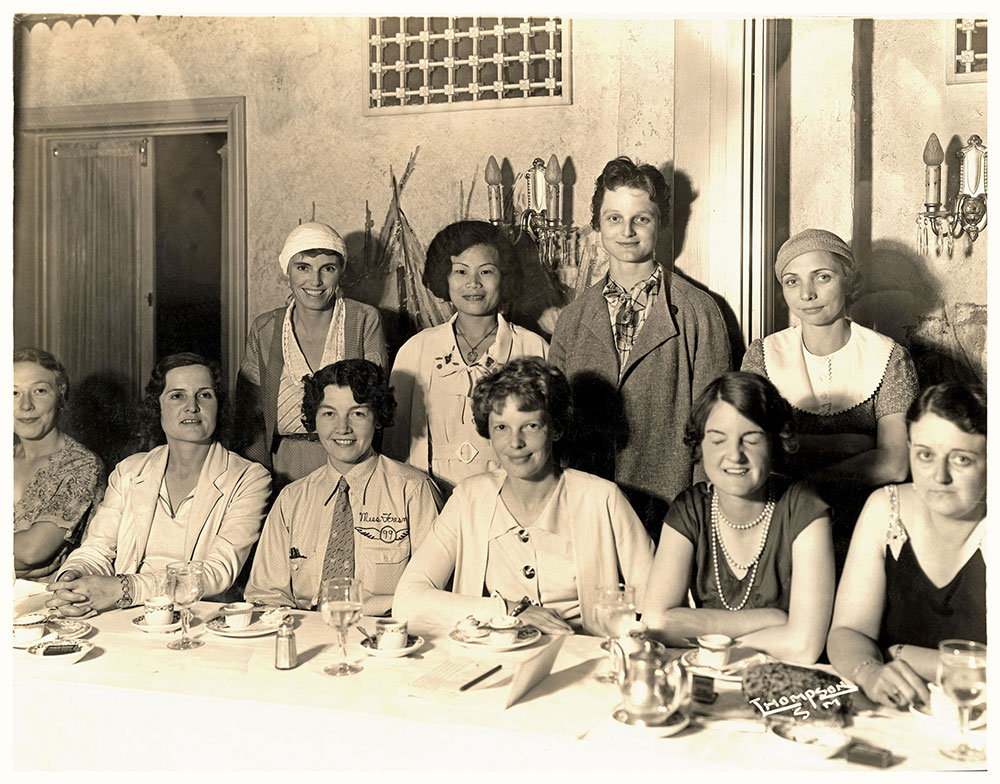
Katherine Cheung standing behind Amelia Earhart during a Ninety-Nines gathering. COURTESY OF DOROTHY "DOTTIE" LESCHENKO
In 1935, Katherine became an American citizen and also earned her international flying license. She traveled the coast visiting cities with large Chinese American communities and collecting money and supplies for China, which was then occupied by Japan.
The following year, Chinese Americans raised $2,000 to buy her a 125-horsepower Fleet biplane, which she flew in a seven-day race from Los Angeles to Cleveland. According to her obit in the Los Angeles Times, “She barely made it over the Rockies and came in next to last, but she was not the least embarrassed.”
Her next big dream was to return to China and open a flight school for Chinese women and contribute to the war effort. But in 1937, her cousin crashed the $7,000 plane she had purchased for the school with donations from the Chinese community.
"I still feel very bad about it," recalled Katherine in a 1980 interview with Jade magazine. "Not only could I not fulfill my goal of establishing a flying school, but I disappointed so many people who unselfishly contributed towards it. I still wish that I could apologize to each of them."
That same year of the plane crash, her friend Amelia Earhart disappeared while attempting to fly around the world and her father fell ill. In an interview with a local TV station, Katherine said her father, on his deathbed, made her swear to give up flying and take care of her mother.
While she did agree, she still flew and but had attempted to get her instructor's pilot licence to teach but was denied multiple times. It is believed that it was due to anti-Asian sentiment during WWII.
She hung up her wings for good when she was 38.
Katherine overcame both cultural and gender expectations in a time when Chinese women were expected to be meek and quiet.
Two statues have been built to honor Katherine in her hometown in China. A documentary was created on her remarkable life. She was inducted into the Women in Aviation International Pioneer Hall of Fame. She is listed in the Smithsonian's National Air and Space Museum as the nation's first Asian Aviatrix and is included in the Flight Path Walk of Fame near Los Angeles International Airport.
Katherine passed in 2003 and she will always be remembered as “China’s Amelia Earhart.”